
In 2025, the average cost per click (CPC) across 10,000 commercial-intent keywords is $4.51. This figure emphasizes the need for businesses to grasp the costs of Google Ads. It’s a critical aspect for any company looking to thrive in the digital landscape.
As more businesses allocate their marketing budgets to online channels, Google Ads stands out as a vital tool for reaching customers. Yet, the cost of advertising on Google can be overwhelming, posing a significant challenge for small and medium-sized enterprises.
This article aims to offer a detailed overview of Google Ads costs. It will cover the elements that affect pricing and provide strategies to enhance your return on investment (ROI).
Key Takeaways
- Understand the average cost per click (CPC) for your industry
- Learn how to optimize your Google Ads campaigns for better ROI
- Discover the factors that influence Google Ads pricing
- Explore strategies to reduce your Google Ads costs
- Maximize your ROI with effective Google Ads management
Understanding Google Ads Pricing Models
Grasping the various pricing models of Google Ads is essential for successful advertising. Google Ads provides several models to suit diverse advertising tactics and business objectives.
Cost-Per-Click (CPC) Explained
Cost-Per-Click (CPC) is a widely used pricing model in Google Ads. It requires payment for each ad click.
How CPC Bidding Works
Advertisers in CPC bidding set a maximum cost per click. The actual cost can be less, influenced by the ad auction.
When to Use CPC Bidding
CPC bidding suits businesses aiming to increase website traffic or generate leads. It’s most effective for search campaigns, where users are actively seeking products or services.
The average CPC on Google Ads varies by industry, but as of 2025, it’s around $5.26. This emphasizes the need for optimizing ad campaigns for a strong return on investment.
Cost-Per-Mille (CPM) Advertising
CPM advertising charges for every 1,000 ad impressions. It’s commonly used for brand awareness campaigns, aiming to reach a broad audience.
Cost-Per-Acquisition (CPA) Bidding
CPA bidding pays only when a user completes a specific action, like a purchase or form submission. It’s beneficial for businesses with clear conversion tracking.
Understanding these pricing models allows advertisers to select the most suitable approach for their goals and budget. Whether it’s CPC, CPM, or CPA, each model has unique benefits and can be optimized for maximum ROI.
How Much Would It Cost to Advertise on Google: Breaking Down the Basics
Google Ads pricing can seem complex, but understanding the basics is key for businesses. The cost to advertise on Google varies based on several factors. These include industry benchmarks, minimum budget requirements, and the type of business.
Average Industry Benchmarks
Industry benchmarks offer a starting point for grasping Google Ads costs. On average, businesses spend between $20 to $50 daily on Google Ads. Yet, this range can change significantly based on the industry and target audience.
B2B vs. B2C Cost Differences
B2B and B2C companies face different advertising costs due to their target audiences and marketing goals. B2B companies usually have higher cost-per-click (CPC) rates. This is because their target audience is more specific and valuable.
| Industry Type | Average CPC | Daily Budget Range |
|---|---|---|
| B2B | $5-$15 | $50-$200 |
| B2C | $1-$5 | $20-$100 |
Minimum Budget Requirements
Google Ads doesn’t enforce a strict minimum budget. Yet, setting a budget too low can restrict ad visibility. A daily budget of $10-$20 is often seen as the minimum for most campaigns.
Realistic Budget Expectations for Small Businesses
Small businesses should aim for a starting budget of $500 to $2,000 monthly for Google Ads. This range allows for enough data collection and campaign optimization.
Google Ads experts advise, “Starting with a budget that is too low can result in your ads not being shown frequently enough to gather meaningful data.” A well-thought-out budget is essential for your Google Ads campaign’s success.
“A well-planned budget is essential for your Google Ads campaign’s success.”
Factors That Influence Your Google Ads Costs
For businesses, grasping the factors that sway Google Ads costs is key to budget management. The cost of Google Ads fluctuates, influenced by elements that advertisers must understand to refine their campaigns.
Industry Competition
Industry competition is a major factor in google adwords cost. As more businesses vie for the same audience, demand for ad space rises, elevating costs. High-competition sectors, like finance or insurance, face steeper google ads pricing due to the intense battle for specific keywords.
Keyword Competitiveness
Keyword competitiveness is another critical aspect. High-cost keywords are those with intense competition and higher CPCs. These keywords are often tied to industries with high profit margins or significant competition.
High-Cost vs. Low-Cost Keywords
Distinguishing between high-cost and low-cost keywords is essential. High-cost keywords are typically found in competitive industries, whereas low-cost keywords might be less competitive but valuable for targeting specific audiences. Advertisers must strike a balance in their keyword strategy to manage google advertising costs effectively.
Quality Score Impact
Google’s Quality Score has a significant impact on ad costs. A higher Quality Score signals that an ad is relevant and useful, potentially lowering costs and improving ad positioning. Key factors influencing Quality Score include ad relevance, landing page quality, and click-through rate.
Ad Relevance and Landing Page Experience
Ad relevance and landing page experience are critical for reducing google adwords cost. Ensuring ads align with targeted keywords and landing pages offer a superior user experience can boost Quality Score, reducing costs. An optimized landing page can greatly enhance a Google Ads campaign’s performance.
Google Ads Bidding Strategies Explained
Mastering Google Ads bidding strategies is key to boosting your return on ad spend. Google Ads presents a variety of bidding strategies. These can help you meet your advertising objectives, such as driving conversions, generating leads, or boosting brand awareness.
Manual CPC Bidding
Manual CPC bidding lets you control your ad spend by setting your own bids. It’s perfect for advertisers who deeply understand their audience and the competitive market.
Automated Bidding Options
Automated bidding options, powered by machine learning, optimize bids in real-time. Target CPA bidding and Maximize Conversions strategy are among the most popular choices.
Target CPA Bidding
Target CPA bidding sets a target cost per acquisition. Google Ads then adjusts your bids to hit this target.
Maximize Conversions Strategy
The Maximize Conversions strategy focuses on maximizing conversions within your budget.
Choosing the Right Strategy for Your Budget
When selecting a bidding strategy, consider your goals, budget, and target audience. “The key to a successful Google Ads campaign is finding the right balance between bid strategy and budget.” By grasping the various bidding strategies, you can make informed choices. This optimizes your ad spend for enhanced results.
Setting Up Your First Google Ads Budget
When starting your first Google Ads campaign, setting the right budget is key. A well-thought-out budget ensures your ads are effective and meet your business objectives.
Daily vs. Monthly Budget Planning
Google Ads lets you set budgets at campaign and ad group levels. You can opt for daily or monthly budgeting. Daily budgets are the average daily spend, while monthly budgets are the total monthly spend.
Small businesses often find daily budgets more manageable. The typical starting budget for SMBs is $1,000-$2,500 monthly, which is about $33-$83 daily.
Campaign-Level Budget Allocation
Effectively allocating your budget across campaigns is essential. Consider each campaign’s performance and goals when deciding on allocations.
Budget Distribution Across Ad Groups
Within campaigns, budget distribution across ad groups is possible. This lets you focus on ad groups that perform well and align with your audience.
For example, allocate more budget to ad groups with high click-through or conversion rates. This strategy can enhance ROI.
Budget Adjustments Based on Performance
Regularly monitoring your Google Ads performance is critical. Adjustments may be needed based on data. Increase budgets for high-performing campaigns or ad groups to maximize ROI.
| Budget Type | Description | Recommended For |
|---|---|---|
| Daily Budget | Average amount spent per day | Small Businesses, New Campaigns |
| Monthly Budget | Total amount spent over a month | Established Campaigns, Large Businesses |
Google Ads Cost by Campaign Type
The cost of Google Ads varies significantly across different campaign types, including Search, Display, and Video campaigns. Understanding these costs is essential for businesses aiming to optimize their advertising budgets effectively.
Search Network Campaign Costs
Search Network campaigns tend to have higher Cost-Per-Click (CPC) rates compared to Display Network campaigns. This is because Search Network ads are displayed to users actively searching for specific keywords, making them more targeted and often more competitive.
For instance, industries like insurance and finance often see higher CPCs due to intense competition. Businesses in these sectors need to carefully plan their budgets to achieve a satisfactory Return on Ad Spend (ROAS).
Display Network Pricing
Display Network campaigns, on the other hand, are often used for brand awareness and can have lower CPCs. These campaigns are billed based on Cost-Per-Mille (CPM), where advertisers pay for every 1,000 impressions.
Video Advertising Costs
Video advertising on Google Ads, particular on YouTube, offers a range of pricing options. The costs can vary based on factors like ad format, targeting options, and audience engagement.
YouTube Ad Format Pricing
YouTube ads can be priced using models like CPM or Cost-Per-View (CPV). The choice between these models depends on the campaign goals, such as maximizing views or driving conversions.
Shopping Campaign Expenses
Shopping campaigns are product-based and are typically used by e-commerce businesses. The costs for these campaigns can be influenced by factors like product pricing, competition, and the quality of product data.
| Campaign Type | Typical Cost Model | Average Cost Range |
|---|---|---|
| Search Network | CPC | $0.50 – $5.00 per click |
| Display Network | CPM | $0.50 – $5.00 per 1,000 impressions |
| Video Advertising | CPV/CPM | $0.10 – $0.30 per view or $2.00 – $10.00 per 1,000 impressions |
| Shopping Campaigns | CPC | $0.50 – $5.00 per click |
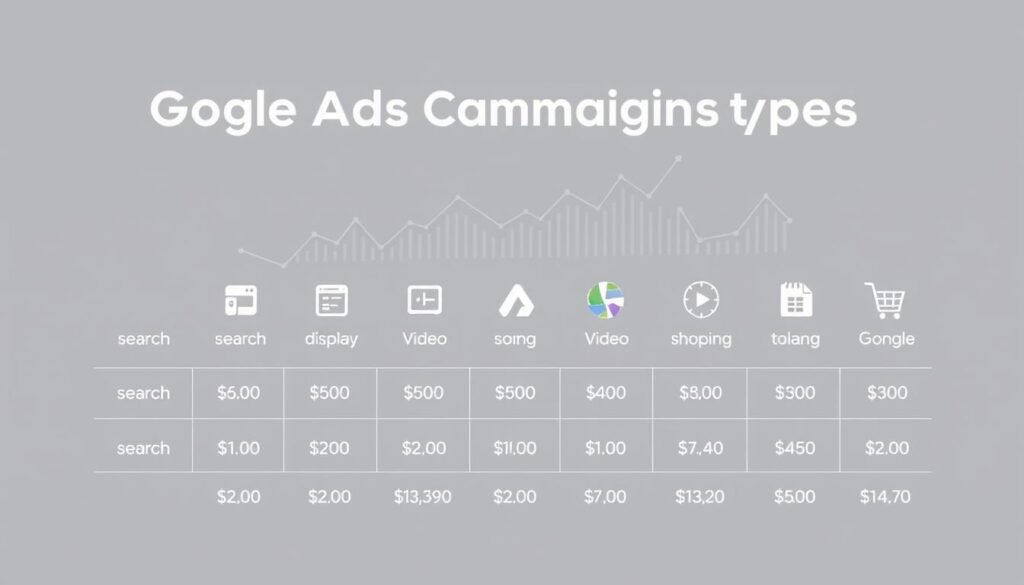
By understanding the cost structures associated with different Google Ads campaign types, businesses can make informed decisions about their advertising strategies and budget allocations.
Hidden Costs of Google Advertising
The true cost of Google Ads extends beyond the obvious expenses. It includes several hidden costs that advertisers must recognize. While Google Ads can be very effective, managing and optimizing campaigns require a lot of resources.
Management Time and Resources
Effectively managing Google Ads campaigns requires a lot of time and expertise. Advertisers must constantly monitor performance, adjust bids, and optimize ad copy. This ensures the best possible return on investment.
Creative Development Expenses
Creating compelling ad creatives is key to the success of Google Ads campaigns. This involves costs for designing ads, writing persuasive copy, and producing high-quality visuals.
Ad Copy Testing Costs
Testing different versions of ad copy is vital for campaign optimization. This process involves creating multiple ad variations and analyzing their performance. It can increase the overall cost.
Tracking and Analytics Tools
To measure the effectiveness of Google Ads campaigns, businesses often need to invest in tracking and analytics tools. These tools help understand user behavior, conversion rates, and other key performance indicators.
Calculating Your Google Ads ROI
Understanding the ROI of your Google Ads is vital for wise budget allocation. It requires grasping the essential elements of ROI calculation.
Setting Up Conversion Tracking
To start calculating your Google Ads ROI, you must set up conversion tracking. Identify the actions you desire your customers to take, like buying or filling out forms. Tracking these conversions allows you to gauge your ad effectiveness.
Determining Cost Per Conversion
With conversion tracking in place, you can calculate your cost per conversion. This is done by dividing your total ad spend by the number of conversions. For example, if you spent $1000 on ads and got 50 conversions, your cost per conversion is $20.
Industry Benchmark Comparisons
Comparing your cost per conversion to industry benchmarks is essential. It shows if your campaigns outperform or underperform the average in your field.
Measuring Return on Ad Spend (ROAS)
ROAS is a key metric for assessing your Google Ads campaign success. It’s found by dividing the revenue from your ads by their cost. For instance, if your ads brought in $5000 and cost $1000, your ROAS is 500%.
| Metric | Formula | Example |
|---|---|---|
| Cost Per Conversion | Total Ad Spend / Number of Conversions | $1000 / 50 = $20 |
| ROAS | Revenue Generated / Ad Spend | $5000 / $1000 = 500% |

Cost-Saving Strategies for Google Ads
To maximize your Google Ads campaign, it’s essential to adopt cost-saving strategies. By optimizing your ads and targeting, you can lower your google advertising costs without sacrificing performance.
Keyword Optimization Techniques
Optimizing your keywords is a key strategy for saving on Google Ads. It involves choosing the right keywords that align with your business and have a reasonable cost-per-click (CPC).
Long-Tail Keyword Opportunities
Utilizing long-tail keywords is a cost-effective approach. These specific phrases have lower competition and often lower CPCs, making them perfect for businesses with tight budgets.
Ad Schedule Refinement
Examining your ad performance data can reveal the best times and days for your ads. By fine-tuning your ad schedule, you can cut down on wasted spend and enhance campaign efficiency.
Geographic Targeting Adjustments
Adjusting your geographic targeting can also lead to significant cost savings. By focusing on regions where your ads perform well and reducing or eliminating spend in underperforming areas, you can optimize your google adwords cost.
Negative Keyword Implementation
Implementing negative keywords is another strategy to save on Google Ads. By excluding irrelevant searches, you can avoid unnecessary clicks and lower your overall costs, improving your return on ad spend (ROAS).
By adopting these cost-saving strategies, advertisers can optimize their Google Ads budget. Regularly reviewing and adjusting your campaigns with tools like the google ads cost calculator ensures you’re achieving the best ROI.
Using Google Ads Cost Calculator Tools
Google Ads cost calculator tools are vital for businesses setting their advertising budgets. They enable advertisers to estimate costs and make strategic campaign decisions.
Official Google Ads Planning Tools
Google offers official tools for cost estimation. The Google Ads Keyword Planner is key for forecasting keyword costs and finding relevant search terms. The Google Ads Budget Simulator also helps predict how budget changes affect campaign outcomes.
Third-Party Budget Estimation Tools
Third-party platforms also provide budget estimation and forecasting services. Tools like SEMrush and Ahrefs offer detailed analysis and forecasting. They help advertisers fine-tune their budget planning.
Interpreting Calculator Results Accurately
Accurate interpretation of Google Ads cost calculator results is essential. Advertisers must consider industry competition, keyword competitiveness, and quality score. Understanding these factors allows for better budget decisions and campaign optimization.
When to Consider Professional Google Ads Management
Professional Google Ads management can revolutionize a business’s ROI. As campaigns grow in complexity, managing them in-house becomes daunting. Professional management brings expertise that boosts ad performance significantly.
In-House vs. Agency Management Cost Comparison
Cost is a key factor when choosing between in-house and agency management. Here’s a detailed comparison:
| Aspect | In-House Management | Agency Management |
|---|---|---|
| Initial Setup Cost | High | Low |
| Ongoing Management Cost | Variable | Fixed |
| Expertise Level | Limited | High |
Finding the Right Google Ads Partner
To find the ideal Google Ads partner, focus on agencies with a strong industry track record. Look for certifications, client feedback, and case studies. Their strategies should match your business objectives.
Evaluating Management Fee Structures
Agencies employ different fee models, such as percentages, flat fees, or performance-based. It’s essential to grasp these to select an agency that fits your budget and goals.
Considering professional Google Ads management can lower your google adwords cost while increasing campaign success. This results in more effective google ads pricing and reduced google advertising costs.
Conclusion
The cost of Google Ads varies widely, influenced by several key factors. These include industry competition, keyword competitiveness, and quality score. Each plays a significant role in determining the final cost.
Understanding Google Ads pricing is essential for maximizing ROI. By familiarizing oneself with different pricing models like CPC, CPM, and CPA, businesses can make more informed budget decisions. This knowledge is vital for optimizing advertising campaigns.
| Factor | Impact on Cost |
|---|---|
| Industry Competition | High competition increases costs |
| Keyword Competitiveness | More competitive keywords cost more |
| Quality Score | Higher quality scores reduce costs |
To achieve better results from Google Ads, advertisers must consider these factors. Optimizing campaigns based on these elements can lead to improved outcomes. Effective Google advertising costs management requires ongoing monitoring and adjustments. This ensures the highest ROI possible.
Sources
The data on Google Ads costs comes from trusted sources to ensure its accuracy and relevance. For a deeper look into google ads pricing, google advertising costs, and google ad cost per click, check out these resources:
- Google Ads Support
- Google Ads Resources
- WordStream Google Ads Guide
These resources provide detailed guides and updates on google ads pricing models. They help advertisers understand their google advertising costs better.
FAQ
How much does it cost to advertise on Google?
The cost of Google ads varies widely. It depends on industry competition, keyword competitiveness, and ad relevance. On average, businesses pay between
FAQ
How much does it cost to advertise on Google?
The cost of Google ads varies widely. It depends on industry competition, keyword competitiveness, and ad relevance. On average, businesses pay between $0.50 to $5 per click. But, costs can skyrocket in competitive industries.
What is the average cost-per-click (CPC) for Google Ads?
The average CPC for Google Ads ranges from $1 to $2 per click. Yet, industries like insurance and finance can see CPCs up to $10 or more.
How do I determine my Google Ads budget?
To set your Google Ads budget, consider your business goals and industry benchmarks. Also, look at the cost of your target keywords. Start with a conservative budget and adjust as needed based on campaign performance.
What is the minimum budget required for Google Ads?
Google Ads doesn’t have a minimum budget requirement. But, a very low budget can limit your ad visibility and campaign effectiveness.
How can I reduce my Google Ads costs?
To cut Google Ads costs, optimize your keywords and refine your ad schedule. Implement negative keywords too. Improving your Quality Score and ad relevance can also lower costs.
What is the difference between daily and monthly budget planning for Google Ads?
Daily budget planning sets a daily budget for your campaigns. Monthly budget planning sets a budget for the entire month. Google Ads will adjust your daily spend to meet your monthly budget.
How do I calculate my Google Ads ROI?
To calculate your Google Ads ROI, track your conversions and determine your cost per conversion. Measure your return on ad spend (ROAS) to understand your campaign’s effectiveness.
What are the benefits of using automated bidding strategies for Google Ads?
Automated bidding strategies can optimize your bids for maximum ROI and save time. They improve campaign performance. But, they might not fit all businesses. Manual CPC bidding could be better in some cases.
How can I estimate my Google Ads costs using a cost calculator tool?
Google Ads cost calculator tools estimate costs based on your business goals, industry, and target keywords. Use official Google Ads planning tools or third-party budget estimation tools for an accurate estimate.
When should I consider hiring a professional Google Ads manager?
Consider hiring a professional Google Ads manager if you lack time or expertise. Or, if you’re not seeing desired results from your advertising efforts.
.50 to per click. But, costs can skyrocket in competitive industries.
What is the average cost-per-click (CPC) for Google Ads?
The average CPC for Google Ads ranges from
FAQ
How much does it cost to advertise on Google?
The cost of Google ads varies widely. It depends on industry competition, keyword competitiveness, and ad relevance. On average, businesses pay between $0.50 to $5 per click. But, costs can skyrocket in competitive industries.
What is the average cost-per-click (CPC) for Google Ads?
The average CPC for Google Ads ranges from $1 to $2 per click. Yet, industries like insurance and finance can see CPCs up to $10 or more.
How do I determine my Google Ads budget?
To set your Google Ads budget, consider your business goals and industry benchmarks. Also, look at the cost of your target keywords. Start with a conservative budget and adjust as needed based on campaign performance.
What is the minimum budget required for Google Ads?
Google Ads doesn’t have a minimum budget requirement. But, a very low budget can limit your ad visibility and campaign effectiveness.
How can I reduce my Google Ads costs?
To cut Google Ads costs, optimize your keywords and refine your ad schedule. Implement negative keywords too. Improving your Quality Score and ad relevance can also lower costs.
What is the difference between daily and monthly budget planning for Google Ads?
Daily budget planning sets a daily budget for your campaigns. Monthly budget planning sets a budget for the entire month. Google Ads will adjust your daily spend to meet your monthly budget.
How do I calculate my Google Ads ROI?
To calculate your Google Ads ROI, track your conversions and determine your cost per conversion. Measure your return on ad spend (ROAS) to understand your campaign’s effectiveness.
What are the benefits of using automated bidding strategies for Google Ads?
Automated bidding strategies can optimize your bids for maximum ROI and save time. They improve campaign performance. But, they might not fit all businesses. Manual CPC bidding could be better in some cases.
How can I estimate my Google Ads costs using a cost calculator tool?
Google Ads cost calculator tools estimate costs based on your business goals, industry, and target keywords. Use official Google Ads planning tools or third-party budget estimation tools for an accurate estimate.
When should I consider hiring a professional Google Ads manager?
Consider hiring a professional Google Ads manager if you lack time or expertise. Or, if you’re not seeing desired results from your advertising efforts.
to per click. Yet, industries like insurance and finance can see CPCs up to or more.
How do I determine my Google Ads budget?
To set your Google Ads budget, consider your business goals and industry benchmarks. Also, look at the cost of your target keywords. Start with a conservative budget and adjust as needed based on campaign performance.
What is the minimum budget required for Google Ads?
Google Ads doesn’t have a minimum budget requirement. But, a very low budget can limit your ad visibility and campaign effectiveness.
How can I reduce my Google Ads costs?
To cut Google Ads costs, optimize your keywords and refine your ad schedule. Implement negative keywords too. Improving your Quality Score and ad relevance can also lower costs.
What is the difference between daily and monthly budget planning for Google Ads?
Daily budget planning sets a daily budget for your campaigns. Monthly budget planning sets a budget for the entire month. Google Ads will adjust your daily spend to meet your monthly budget.
How do I calculate my Google Ads ROI?
To calculate your Google Ads ROI, track your conversions and determine your cost per conversion. Measure your return on ad spend (ROAS) to understand your campaign’s effectiveness.
What are the benefits of using automated bidding strategies for Google Ads?
Automated bidding strategies can optimize your bids for maximum ROI and save time. They improve campaign performance. But, they might not fit all businesses. Manual CPC bidding could be better in some cases.
How can I estimate my Google Ads costs using a cost calculator tool?
Google Ads cost calculator tools estimate costs based on your business goals, industry, and target keywords. Use official Google Ads planning tools or third-party budget estimation tools for an accurate estimate.
When should I consider hiring a professional Google Ads manager?
Consider hiring a professional Google Ads manager if you lack time or expertise. Or, if you’re not seeing desired results from your advertising efforts.